The Business Guinea Pigs – Volume 3: Rocky Becomes the Boss!
Revenue and profit explained simply for kids: Rocky starts a company.
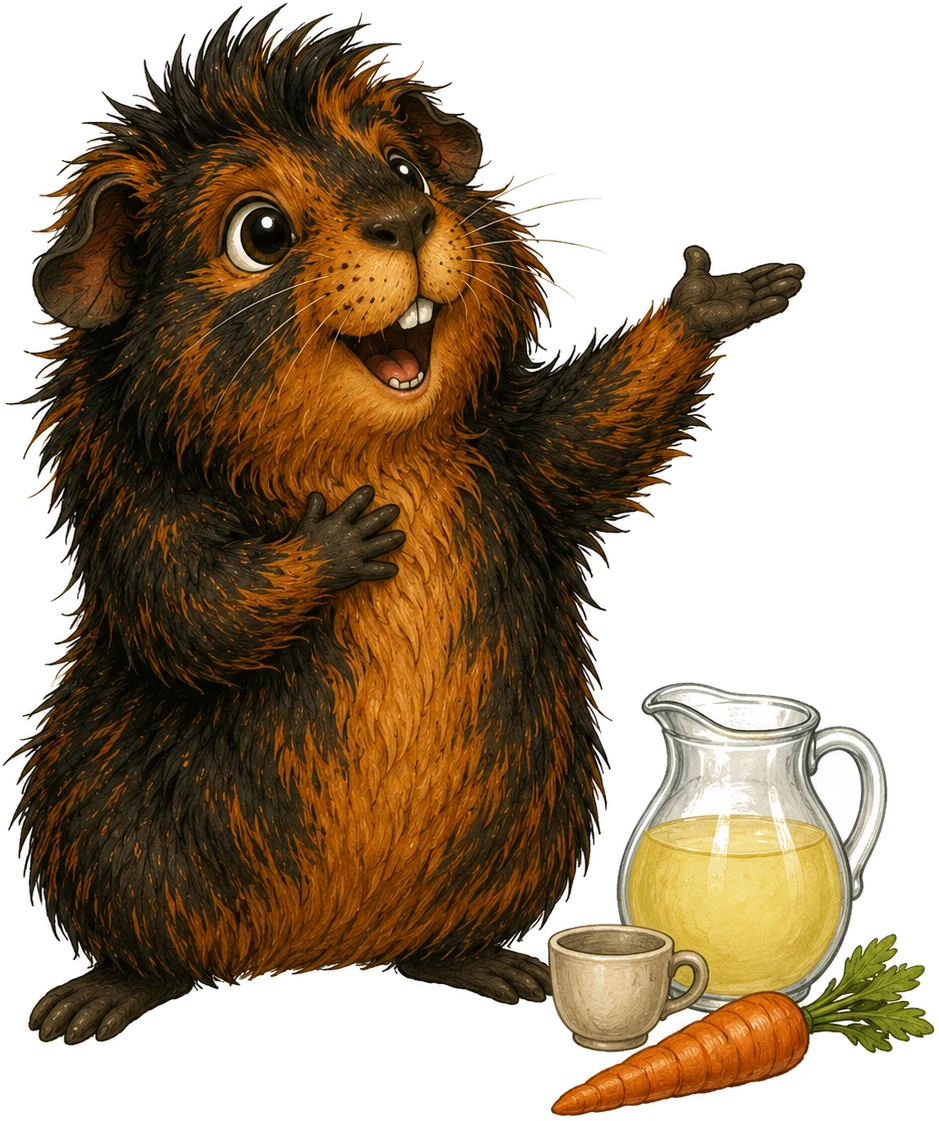
Rocky has had enough. He’s starting a company, with himself as managing director, head of show and Chief Carrot Officer. To him, a company is a name in big letters and a boss who calls the shots. Mr. Grey sees it a little differently.
At the summer block party, the lemonade stand is supposed to become “Rocky’s Squeak & Squeeze,” with lemonade, carrot sticks and a show. By the end of the day, they’ve taken in a lot of money. And earned almost nothing.
- By Daria Helck, published by FLITCH UG
- For kids ages 10 and up, roughly grades 5 to 7
- Bilingual: every paragraph in German, with the English right below it
- 52 pages, illustrated in full color throughout
- Available as a paperback and as a Kindle eBook
Paperback €14.99 · Kindle eBook €7.99 · Prices on Amazon as of October 2026

Good to know: every book in the series is bilingual. Each paragraph is printed in German, with the English right below it, so kids can enjoy the story in English and pick up German along the way.
What Volume 3 is about
Rocky hands out departments. He’s the boss himself, because he said it out loud first. Christian’s math pops the dream, and he crosses the fog machine off the shopping list. Mr. Grey explains what a business idea needs and who you’re actually selling to. And when Rocky puts the table up on a hay bale and has the cups filled to the brim, everyone learns what liability means.
At the party, Rocky gives so many mixed-up orders that Daria calls him a furry traffic jam. Cups filled to the brim, free refills: the stand takes in a lot and still earns almost nothing. During a break, Rocky admits his mistakes. The jobs get handed out again based on everyone’s strengths, and by evening there’s a small profit left. Small, but real.

Revenue and profit explained simply: what Volume 3 teaches
The book answers these questions. Here’s a quick summary, with the examples from the story.
What’s the difference between revenue and profit?
Revenue and profit aren’t the same thing. Revenue is all the money that comes in. Profit is what’s left at the end, once the costs are paid. At the summer party, lots of people buy lemonade, and the revenue is huge. But the cups are filled to the brim, and the sign says “free refills.” So the same lemon goes across the table three times for nothing. Christian sums it up: Our revenue is huge, it’s just that our profit is almost gone.
How do you turn lots of revenue into profit, too?
By getting the costs under control. Mr. Grey says the most expensive mistake a young boss can make is forgetting that revenue is not profit. The fix in the book is very practical: fill the cups properly, drop the free refills, and move the table off the hay bale and onto the ground. After that, a small profit is left, and it gets split up: part goes into the reserve, part into the next stand, and a little bit into the guinea pigs’ cash box.
What’s the difference between a stand and a company?
Mr. Grey explains: A nice name isn’t a company yet. A kid who sells cookies for one day has a stand. A company sells or offers something again and again, planned, regularly, for lots of people. Christian adds: For that you need materials, prices, responsibility and a reason.
What makes a good business idea?
Mr. Grey lists it. First, the idea itself: What are you offering, and why do people need it? At a hot summer party, there’s real demand for cold lemonade. Second, the target group: Who exactly is the offer for? Kids who are playing and sweating, parents who want a break. And when it comes to the name, Daria has the best tip: It has to appeal to the customers, not just to Rocky.
What is startup capital, and what is an investment?
Before the first customer pays a single cent, the stand already needs lemons, sugar, cups, a sign, a table, a cooler and change. That money at the start is called startup capital. You have to put it up ahead of time. Some things, like a good cooler, cost money but help more things work out later. That’s an investment. Rocky’s fog machine isn’t one. The guinea pigs’ rule: do the math first, then act.
Make it yourself or buy it: which is better?
It depends, and not just on money but on time, too. Squeezing your own lemonade is cheaper but takes a while. Ready-made lemonade is faster, costs more and doesn’t taste as special. A homemade sign is cheap and looks like the kids made it. Mr. Grey: There’s no answer that’s right forever. You have to think it through again every time.
Do kids have to register a business for a lemonade stand?
The book deliberately plays it safe here. For a single small kids’ stand on one afternoon, it’s often enough that adults are around and the organizer knows about it. In Germany, anyone who wants to earn money regularly often has to register a business, so it’s clear who’s responsible. At ten, you don’t set something like that up on your own. You need adults who are in on it. Mr. Grey says: A form is sometimes a friend, not an enemy.
What does liability mean, and what is a GmbH?
When lemonade sloshes out of an overfilled cup onto a kid’s picture book, Christian explains: If something gets damaged because of a company, someone has to answer for it. That’s called liability. Mr. Grey adds: Risks belong to the boss, not to the table. With some kinds of companies, liability is limited, and the GmbH, a kind of limited company in Germany, is one of them. Rocky wants one right away. Mojito says no: You don’t start a GmbH because it sounds bigger. You start one when you know why you need it.
What makes a good boss?
Not the loudest one, and not the one who got there first. Mr. Grey: A boss is the one who takes responsibility. Who makes the call when nobody else dares to, and owns it when something goes wrong. Being the boss doesn’t mean everyone serves you. It means you serve the thing you’re building. Rocky learns it the hard way and says it himself at the end: Being the boss is harder than getting applause.


The most important lines from the book
In the book, every paragraph is in German, with the English right below it. Same here.
- „Ein schöner Name ist noch keine Firma.““A nice name isn’t a company yet.”
- „Chef sein heißt nicht: Alle müssen dir dienen. Chef sein heißt: Du dienst der Sache.““Being the boss doesn’t mean everyone serves you. It means you serve the thing you’re building.”
- „Risiken gehören dem Chef — nicht dem Tisch.““Risks belong to the boss — not to the table.”
- „Umsatz ist nicht Gewinn.““Revenue is not profit.”
- „Eine Firma funktioniert nämlich nicht, weil einer alles bestimmt. Sie funktioniert, weil jeder weiß, wofür er verantwortlich ist.““A company doesn’t work because one person decides everything. It works because everyone knows what they’re responsible for.”
- „Chef sein ist schwerer als Applaus kriegen.““Being the boss is harder than getting applause.”
Words from the book: German and English
At the back of the book is the Business Guinea Pigs’ dictionary. Here are a few of the words:
- Unternehmen · company
Something that sells or offers things in a planned, regular way, not just once. A nice name alone doesn’t make one. - Stand · stand
When you sell something once, on a single day, like lemonade. Not a company yet, but often the start of one. - Geschäftsidee · business idea
The reason for a company: What am I offering, and why do people need it? - Zielgruppe · target group
The people your offer is meant for. Rocky thinks it sounds like a band. - Startkapital · start-up money
The money you need at the start, before the first customer pays. - Investition · investment
Spending money now so more works out later, for example on a good cooler. - Umsatz · revenue
All the money that comes in. The most important sentence in the book: Revenue is not profit. - Haftung · liability
If something gets damaged because of the company, someone has to answer for it. Risks belong to the boss. - Rücklage · reserve
Money you don’t spend but put aside for later. For a rainy day.
Dear parents, Rocky desperately wants to be the boss — ideally with a stage, a glitter logo and applause. Along the way, he learns (and your child with him) that a company is more than a big name: it needs a real idea, a target group, honest math — and above all, someone who takes responsibility.
The strongest moment is deliberately not a triumph but a small flop: the stand takes in a lot and still earns almost nothing. Revenue is not profit — that one insight is what kids take away from the book.
Daria Helck in the afterword of Volume 3

Join in and keep talking
At the back of the book, there’s a profile page just for your child. Your child fills in a business idea and writes down what they would do with the profit. There’s also space to draw a Business Guinea Pig of their own. If they like, they can then plan their own stand, just like in the book: What’s the idea, who is it for, what do you need beforehand, and what’s really left over at the end?
Questions to keep the conversation going
- So what’s the actual difference between a stand and a company?
- Why is so little left at the end, even though so much money came in?
- What would you take responsibility for if you were the boss?
- What would you do with a profit: spend it, save it or invest it again?
What’s inside the book
- 10 chapters, one continuous story
- Every paragraph in German, with the English right below it
- The Business Guinea Pigs’ dictionary with 22 terms in German and English
- Profiles of all six characters
- A profile page of your own to fill in, with a business idea and space to draw
- A word to parents, with questions to keep thinking about
- 52 pages, illustrated in full color throughout
Free in the FLITCH Club: individual worksheets, two coloring pages and pages for parents that go with the books. For sale in the FLITCH shop, all in German: the coloring book (€4.90), Die Schweinchenkasse, an allowance planner (€6.90), and the Advent coloring calendar (€4.90).