The Business Guinea Pigs – Volume 4: Why Is So Little Left?
Gross and net pay explained simply for kids: from a sack of hay to the pay slip.
Rocky writes the company an invoice for a million carrots. He’s the boss, after all, so he’s entitled to it. Mr. Grey only asks: Do bosses even get paid? And if they do, does everything on the slip actually reach them?
Soon after, Knut the gardener honks his horn. He can’t keep up with the work on his own anymore and wants to hire Jonas. Daria and Christian do the math with him and discover that the number at the top of the pay slip is different from the one at the bottom. And Knut actually pays even more than the number at the top.
- By Daria Helck, published by FLITCH UG
- For kids ages 10 and up, roughly grades 5 to 7
- Bilingual: every paragraph in German, with the English right below it
- 88 pages, illustrated in full color throughout
- Available as a paperback and as a Kindle eBook
Paperback €16.99 · Kindle eBook €7.99 · Amazon prices as of October 2026
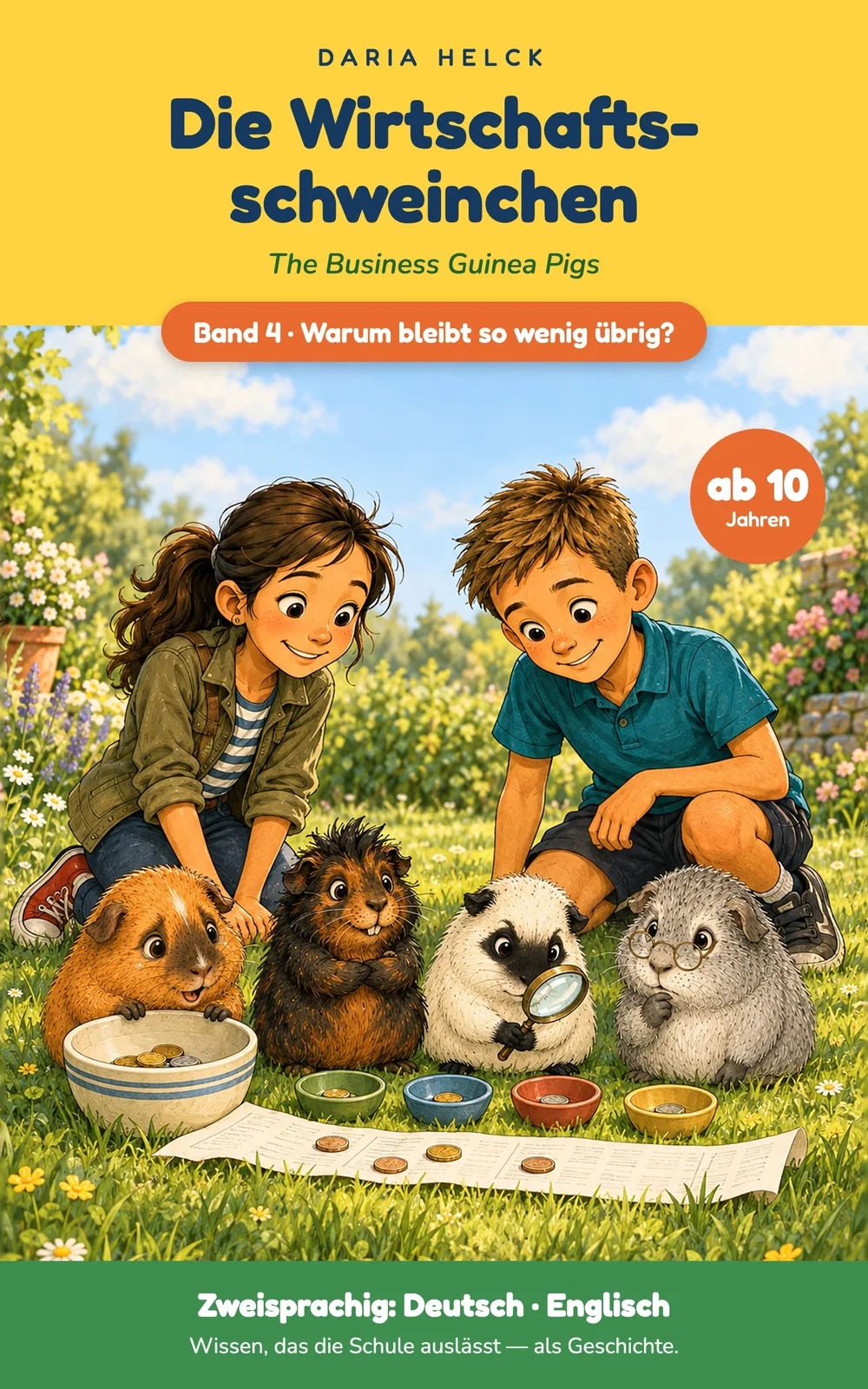
Good to know: every book in the series is bilingual. Each paragraph is printed in German, with the English right below it, so kids can enjoy the story in English and pick up German along the way.
What Volume 4 is about
It all starts with a sack of hay. Knut promised five kilos, Christian’s luggage scale shows six, and the sack itself weighs one. That’s how the kids learn gross, tare and net, and Christian asks the question the whole book hangs on: When it comes to wages, what’s the sack? At Knut’s garden center, Ina the bookkeeper shows them a sample pay slip. Afterward there are six bowls in the enclosure, and Toffy finds the most important line of all: Deducted is not lost.
Then Rocky secretly slips his own employment contract into the folder for Jonas: €3,000 net, plus applause, signed with a paw print. It doesn’t count, because loud is not permission. Rocky starts the Hay Union and goes on strike for eleven seconds. In the end Knut does the math honestly, hires Jonas with a clear gross wage, and with it Jonas even finds an apartment.

Gross and net pay explained simply: what Volume 4 teaches
The book answers these questions. Here’s a quick summary, with the examples from the story.
What is the difference between gross and net pay?
Knut explains it with the sack of hay: hay and sack together are called gross. Take away the sack, the tare, and what’s left is net, the hay. Pay works in a similar way. Gross is the number at the top of the pay slip, the whole wage before anything is taken out. Net is the number at the bottom, what you actually get. In the book’s example for Germany, that’s €3,000 gross and about €2,050 net. Only one thing is different from the hay: with pay, you don’t throw the sack away.
Where do the deductions from your paycheck go?
They don’t go missing, says Ina. The employer withholds the income tax and sends it to the tax office. The employer passes on the insurance contributions too, and keeps none of it. In the enclosure, the guinea pigs set out bowls for this: a big one for the tax, which pays for schools, roads and the fire department, and smaller ones for the insurance. Toffy’s line: Deducted is not lost. It’s just there for someone somewhere else.
What is social insurance in Germany? Explained simply
Four kinds of insurance that employees and employers usually split: health insurance for doctors and hospitals, pension insurance for old age, long-term care insurance for when someone needs help with everyday life, and unemployment insurance for when someone loses their job. Mr. Grey makes a point of it: These are not taxes. And the pension isn’t saved up, either. Toffy calls it a food bowl through time: today, the people who work fill the bowl for the people who are already old. A fifth bowl, accident insurance, is paid by the employer alone.
How much does an employee cost an employer?
More than it says at the top of the pay slip. The employer also pays part of the four kinds of insurance, plus accident insurance and a few smaller required contributions. For Knut’s small garden center, that comes to about €3,700 in the example. Christian draws it as a staircase: Knut pays about 3,700, the slip says 3,000 gross, and about 2,050 arrives net. The proper word for it is labor costs. Rocky calls it ghost wages.
Why is €3,000 net so much more than €3,000 gross?
Rocky promises Jonas €3,000 net, plus applause. Christian notices: Same digits, different number. With net, you have to work backward, and the more someone earns, the bigger the deductions get. In the example, the top line would have to say about €4,750 gross, and Knut would pay almost €5,900 in total. That’s over two thousand euros more, every single month. Jonas puts it this way: I’d rather have a clear gross than a dream net that nobody can deliver.
What is the minimum wage, and how can you tell if pay is fair?
The minimum wage is the lowest amount anyone can be paid for an hour of work. Ina says: The floor is not the ceiling. And legal doesn’t automatically mean fair. Christian writes down three questions for checking a wage: Is it above the floor? What do others pay for similar work? Can the business afford it in the long run? The exact number only appears at the back of the book: in 2026, the minimum wage in Germany is €13.90 an hour.
Do bosses actually get paid?
It depends. If you’re employed, you get a wage, even as the boss. If you own your business yourself, you don’t automatically get a wage. Knut explains it himself at the end: first the supplies, rent, gas, labor costs and the other operating costs get paid. Whatever is left after that is his profit. He still pays taxes on it, and part of it goes into the reserve. Mr. Grey sums it up: Being the boss doesn’t mean helping yourself first.
At what age can kids work?
The back of the book explains it briefly, for Germany: under 13, kids aren’t allowed to work. At 13 and 14, light tasks are allowed, like taking care of pets, but only with the parents’ okay, for no more than two hours a day and never during school hours. From 15 on, jobs during school vacations are allowed too, for up to four weeks a year. Helping out at home is just part of family life, and it doesn’t automatically come with money. Or as Mr. Grey says: Helping for a bit isn’t a job.
Why do you read an employment contract before you sign it?
Because everything important is in it. Knut’s offer to Jonas: €3,000 gross a month, forty hours a week, 28 vacation days, and a six-month probation period. Jonas takes it home, because you don’t sign a contract on the fly. And only someone who is allowed to make a promise can make one. Rocky’s paw-print contract doesn’t count. Mojito’s line: Loud is not permission.



The most important lines from the book
In the book, every paragraph is in German, with the English right below it. Same here.
- „Geld in der Kasse ist noch nicht Gewinn.““Money in the box is not profit yet.”
- „Ein Lohnzettel ist kein Wunschzettel.““A payslip is not a wish list.”
- „Abgezogen ist nicht verloren.““Deducted is not lost.”
- „Laut ist keine Vollmacht.““Loud is not permission.”
- „Der Boden ist nicht die Decke.““The floor is not the ceiling.”
- „Es bleibt gar nicht so wenig übrig. Es bleibt nur nicht alles bei einem.““There isn’t so little left. It just doesn’t all stay with one person.”
Words from the book: German and English
At the back of the book is the Business Guinea Pigs’ dictionary. Here are a few of the words:
- Brutto · gross
The number at the top of the pay slip: the whole wage before anything is taken out. - Netto · net
The number at the bottom: what you actually get. And no, Toffy: it’s not a snack. - Tara · tare
The weight of the packaging. 6 kilos gross, 1 kilo of sack, 5 kilos of hay net. - Lohnzettel · payslip
The pay statement a company has to hand out: gross at the top, deductions in the middle, net at the bottom. - Lohnsteuer · income tax
The tax on wages. The more you earn, the bigger the share you pay. - Sozialversicherung · social insurance
Four kinds of insurance that employees and employers usually split: pension, health, long-term care and unemployment. - Lohnkosten · labor costs
Everything an employee costs the business. Rocky calls it ghost wages. - Mindestlohn · minimum wage
The lowest pay allowed for an hour of work. The floor, not the ceiling. - Vollmacht · permission to promise
Permission to promise something on someone else’s behalf. Without it, the other person doesn’t have to go along with it, not even if there’s a paw print.
The most important insight is in Toffy’s line: Deducted is not lost. Taxes and insurance don’t just disappear. They pay for things people benefit from: school, doctor’s visits, pensions, or help when someone is out of work. The second: an employee costs a business more than it says at the top of the pay slip. Or as Daria says at the end: There isn’t so little left. It just doesn’t all stay with one person.
The kids in the book deliberately see a sample pay slip, not a real one. Whether you show your own is up to you.
Daria Helck in the afterword of Volume 4

Join in and keep talking
At the back of the book it says: Do the math like Christian! Four exercises, for example: A sack of hay weighs eight kilos gross, and the empty sack weighs one kilo. How much hay is inside? There’s also an allowance plan to fill in: How much do I get, how much do I put aside, what’s left for me? The answers are printed upside down.
Questions to keep the conversation going
- Where do the deductions go?
- Why wasn’t Rocky allowed to promise anything?
- How can you tell if a wage is fair?
- How much of your allowance do you put aside?
What’s inside the book
- 10 chapters, one continuous story
- Every paragraph in German, with the English right below it
- Four explainer pictures: sack of hay, pay slip, bowls and staircase
- The Business Guinea Pigs’ dictionary with 19 terms in German and English
- The calculation from the book as an example, as of 2026
- Do the math like Christian!: exercises to work out yourself and an allowance plan
- Good to know: working under 18
- Profiles of all the characters, with Knut, Ina and Jonas new on board
- A word to parents
- 88 pages, illustrated in full color throughout
Free in the FLITCH Club: individual worksheets, two coloring pages and pages for parents that go with the books. For sale in the FLITCH shop, all in German: the coloring book (€4.90), Die Schweinchenkasse, an allowance planner (€6.90), and the Advent coloring calendar (€4.90).