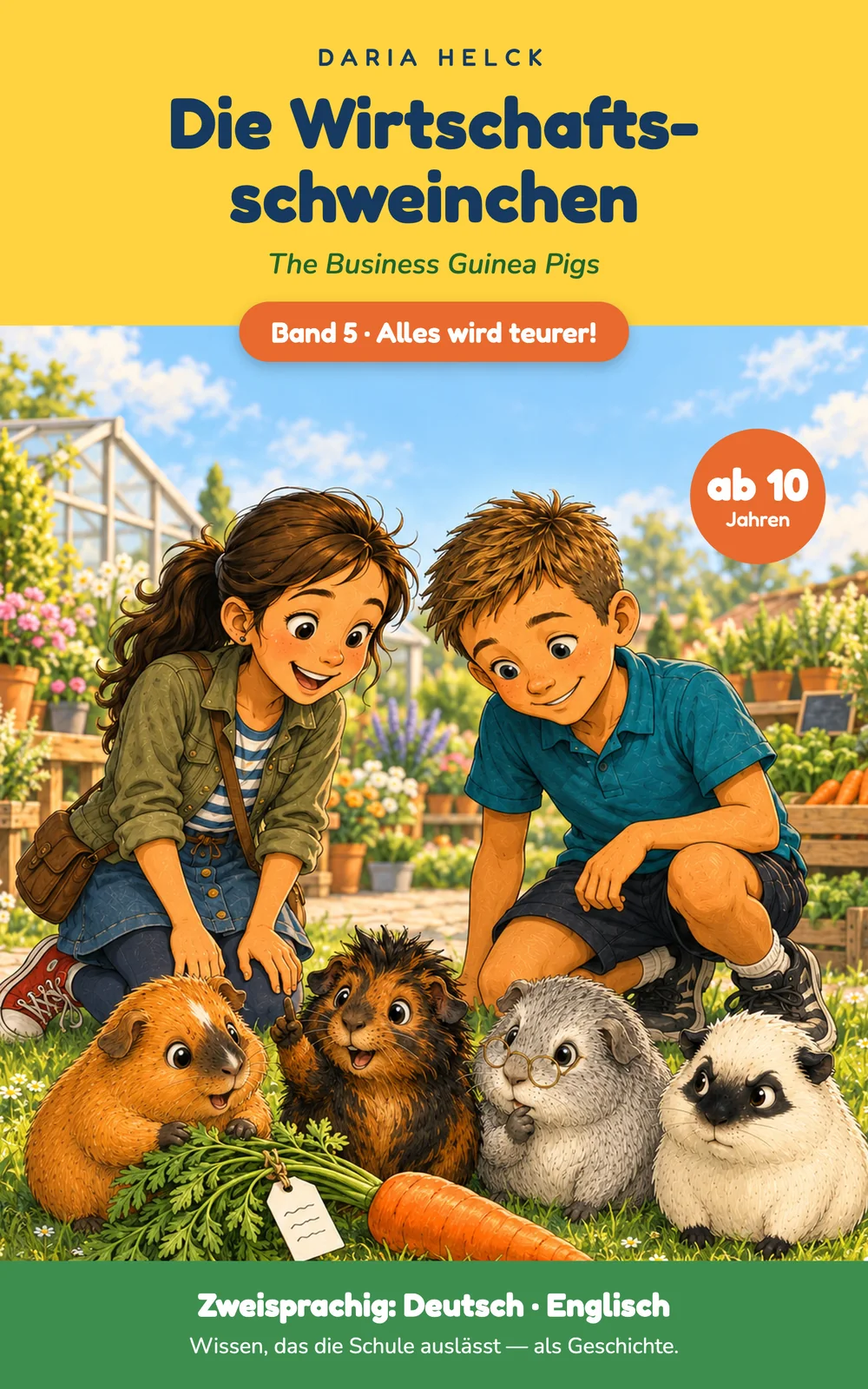
The Business Guinea Pigs – Volume 5: Everything Costs More!
Inflation explained simply for kids: from the price of carrots to the shopping basket.
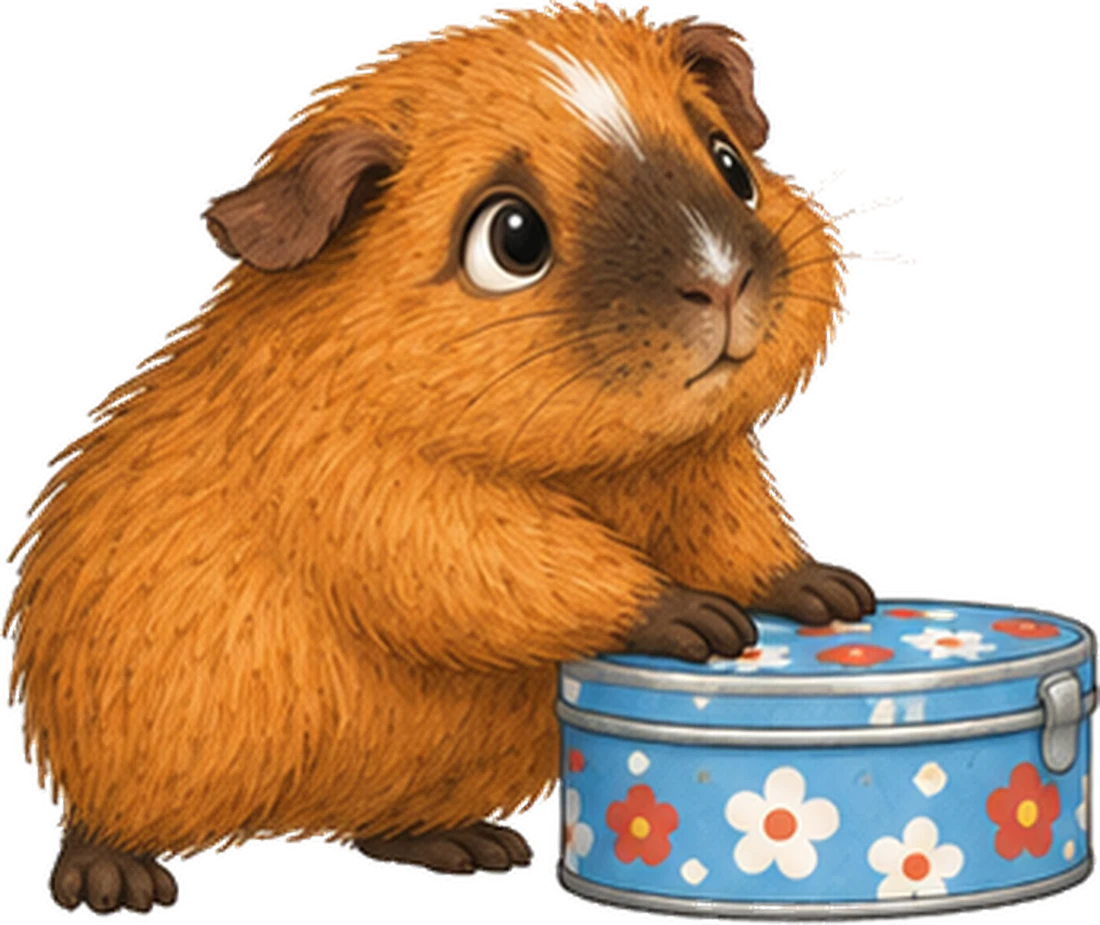
Toffy knows every carrot price tag by heart. That’s why he’s the first to notice that a bunch now costs €1.10 instead of one euro. The two euros in the guinea pigs’ cash box are now only enough for one bunch. There isn’t any less money. It just feels like less.
Daria and Christian don’t just take his word for it. They put together their own shopping basket: the same things, the same amount, the same store, with a date. Ten euros. Then €10.40. Then €11.30. And Knut the gardener stands in front of his chalkboard and doesn’t dare change the price of hay.
- By Daria Helck, published by FLITCH UG
- For kids ages 10 and up, roughly grades 5 to 7
- Bilingual: every paragraph in German, with the English right below it
- 90 pages, illustrated in full color throughout
- Available as a paperback and as a Kindle eBook
Paperback €16.99 · Kindle eBook €7.99 · Amazon prices as of October 2026
Good to know: every book in the series is bilingual. Each paragraph is printed in German, with the English right below it, so kids can enjoy the story in English and pick up German along the way.
What Volume 5 is about
Filip, the boy from down the street, shows up at the fence with a camera and Mrs. Müller’s dachshund, Zottel. Filip takes pictures of price tags before everyone can say: It’s always been like that. With his photos and Christian’s four rules, a feeling turns into a real comparison. At Knut’s farm stand it turns out that hay has gotten a lot more expensive, because the summer was dry. And Ina walks Knut through the numbers to show him why a price isn’t a mood but a calculation.
First Rocky founds the Old Prices Club, and then he has an even worse idea: a loosely stuffed sack with a sign that says SAME PRICE. Christian’s luggage scale shows four kilos instead of five. A deceptive package. Toffy is offended, because his seal is on that sack. Knut writes an honest sign with the unit price instead. And at the end Mr. Grey explains why one expensive carrot is not inflation yet.

Inflation explained simply: what Volume 5 teaches
The book answers these questions. Here’s a quick summary, with the examples from the story.
What is inflation? Explained simply for kids
Mr. Grey puts it like this: Inflation is when lots of prices go up over a longer period of time. The money doesn’t get smaller. It buys less. Daria already nailed it earlier: Not one thing by a lot. Lots of things by a little. Filip’s photos show exactly that: a scoop of ice cream costs €1.70 instead of €1.60, a bread roll 47 cents instead of 45, a bus ticket €1.95 instead of €1.90.
Is a single price increase already inflation?
No. Hay has gotten more expensive because the summer was dry and less of it grew. Next year it may get cheaper again. That’s a single price increase. Mojito just says: Not inflation. That’s expensive hay. Daria writes down the book’s key sentence: One expensive carrot is not inflation yet. And Christian adds: A whole expensive shopping basket is more like it.
What is purchasing power?
Purchasing power is how much you get for your money. Last summer, Toffy’s two euros bought two bunches of carrots. Now one bunch costs €1.10, the two euros are only enough for one, and 90 cents are left over. Mr. Grey’s line: The money doesn’t get smaller. It just buys less. And at the end Toffy realizes: He hasn’t spent a thing, and yet he has less.
What is a shopping basket, and how is inflation measured?
Daria and Christian compare a basket with a basket: two bunches of carrots, two cucumbers, a sack of hay, a sack of bedding. Last summer it cost €10.00, then €10.40, and most recently €11.30. For a whole country there’s a big basket with food, rent, clothes, tickets and much more. In Germany, the Federal Statistical Office calculates it, and the number is called the inflation rate. In a small basket, a single price increase looks bad. In the big one, lots of things even each other out.
How do you compare prices the right way?
With Christian’s four rules: the same item, the same amount, the same store, with a date. If one is missing, it isn’t a comparison, it’s a memory. Filip adds one more question: How do we know that was the normal price and not a sale? His photos of Knut’s chalkboard, taken three weeks apart, are the proof.
Why do prices go up?
Because everything that goes into them is getting more expensive, says Knut: hay from the farmer, electricity for the greenhouse, gas for the delivery van. With hay, there’s also the dry summer. There isn’t much hay, and lots of people want it. Few goods and lots of buyers, and the price goes up. Mrs. Müller, the dental technician, knows this from her own work: Sometimes it isn’t the work that has gotten more expensive. Sometimes it’s the materials.
Does a higher price automatically mean more profit?
No. Ina runs the numbers for Knut: A price is not just a number. A price is a calculation. A sack of hay used to cost him €4.20, he added an 80-cent markup and sold it for €5.00. Now the sack costs him €5.10. At €5.00 he would lose money on every sack. The new price is €5.90, and the 80-cent markup is still 80 cents. Ina’s line: More expensive does not automatically mean greedier.
What is a deceptive package? Shrinkflation explained
A package that looks the same as before but has less inside. Rocky loosely stuffs a big sack with hay and puts SAME PRICE in front of it. The luggage scale shows four kilos instead of five. Filip sums it up: The same price is only the same if the same amount is in it. Knut explains what’s allowed: You can sell smaller sacks, but then it has to say so on them. If the sack looks the same as before even though there’s less inside, it’s fooling people.
What is a unit price?
The unit price tells you what one kilo costs, Ina explains. It makes big and small packages easy to compare, and at home you’ll find it on flour, rice or juice too. Most of the time, nobody reads it. Christian does the math: €5.90 for five kilos is €1.18 per kilo. Rocky’s sack, €5.00 for four kilos, costs €1.25 per kilo. So the same price is more expensive than the expensive price.


The most important lines from the book
In the book, every paragraph is in German, with the English right below it. Same here.
- „Ein Preis ist nicht nur eine Zahl. Ein Preis ist eine Rechnung.““A price is not just a number. A price is a calculation.”
- „Das Geld wird nicht kleiner. Es kauft nur weniger.““The money doesn’t get smaller. It just buys less.”
- „Teurer heißt nicht automatisch gieriger.““More expensive does not automatically mean greedier.”
- „Gleicher Preis ist nur gleich, wenn auch gleich viel drin ist.““The same price is only the same if the same amount is in it.”
- „Mit Vertrauen macht man keine Tricks.““You don’t play tricks with trust.”
- „Eine teure Möhre ist noch keine Inflation.““One expensive carrot is not inflation yet.”
Words from the book: German and English
At the back of the book is the Business Guinea Pigs’ dictionary. Here are a few of the words:
- Kaufkraft · purchasing power
How much you get for your money. Two euros are still two euros, but they buy less. - Warenkorb · shopping basket
The same things every time, used for measuring. €10.00, then €10.40, then €11.30. - Preisvergleich · comparing prices
Same item, same amount, same store, with a date. - Angebot und Nachfrage · supply and demand
Not much hay, lots of buyers: the price goes up. - Aufschlag · markup
What Knut adds on top of his costs at the end. For him, eighty cents. - Mogelpackung · deceptive package
Looks the same as before, but there’s less inside. Less inside is allowed. Fooling people is not. - Grundpreis · unit price
What one kilo costs. €1.18 versus €1.25. - Inflation · inflation
Lots of prices go up over a longer period of time. You get less for the same money. - Inflationsrate · inflation rate
By what percentage the big shopping basket got more expensive in a year. In Germany, the Federal Statistical Office calculates it.
Dear parents, in this volume Daria, Christian and the four guinea pigs notice that the same money suddenly doesn’t go as far. They start small, with a bunch of carrots, and end up asking how a whole country measures whether everything is getting more expensive.
Two insights carry the book. The first is Mr. Grey’s line: The money doesn’t get smaller. It just buys less. The second comes from Ina: A price isn’t a mood, it’s a calculation — and a higher price doesn’t automatically mean more profit. In the end, Knut doesn’t make a single cent more on a sack of hay than he did before.
The unit price on the supermarket shelf is the best place to practice there is, and it doesn’t cost a thing.
Daria Helck in the afterword of Volume 5

Join in and keep talking
At the back of the book it says: Do the math like Christian! Five exercises, for example: A sack weighs four kilos and costs €5.00. What does one kilo cost? There’s also a shopping basket for your child to put together: three things your child buys often, and what they cost together today, with a date. In a year, you do the math again. The answers are printed upside down.
Questions to keep the conversation going
- What goes in your family’s shopping basket?
- Why isn’t it enough to remember an old price?
- How can you spot a deceptive package?
- What does your allowance buy today, and what will it buy a year from now?
What’s inside the book
- 10 chapters, one continuous story
- Every paragraph in German, with the English right below it
- Six explainer pictures, including purchasing power, the shopping basket and the unit price
- The Business Guinea Pigs’ dictionary with 22 terms in German and English
- All the calculations from the book at a glance
- Do the math like Christian!: five exercises and a shopping basket of your own
- Good to know: how to really compare prices
- Profiles of all the characters, with Filip, Mrs. Müller and Zottel new on board
- A word to parents
- 90 pages, illustrated in full color throughout
Free in the FLITCH Club: individual worksheets, two coloring pages and pages for parents that go with the books. For sale in the FLITCH shop, all in German: the coloring book (€4.90), Die Schweinchenkasse, an allowance planner (€6.90), and the Advent coloring calendar (€4.90).