Four real guinea pigs · Books for kids 10 and up · German and English
Economics that makes sense. As a story, not a textbook.
Rocky usually has a plan already. Mr. Grey knows the history behind it. Toffy asks whether it's even fair. And Mojito, of course, has read the fine print. Together they explain money, prices, companies and the government in a way that actually makes sense.
The books are on Amazon and in the FLITCH shop. Their world lives here.
Welcome! The Business Guinea Pigs is a bilingual book series: every paragraph in German, with the English right below it. Kids read the story in English and pick up German along the way. The rules and numbers on this site are the ones that apply in Germany.
Guinea Pig Post
Fresh from the enclosure
The latest from the real guinea pigs, the series and the printables.
Today Rocky, Toffy, Mojito and Mr. Grey moved out of their outdoor enclosure and into their big winter quarters inside the house. A look behind the scenes with the real Business Guinea Pigs.
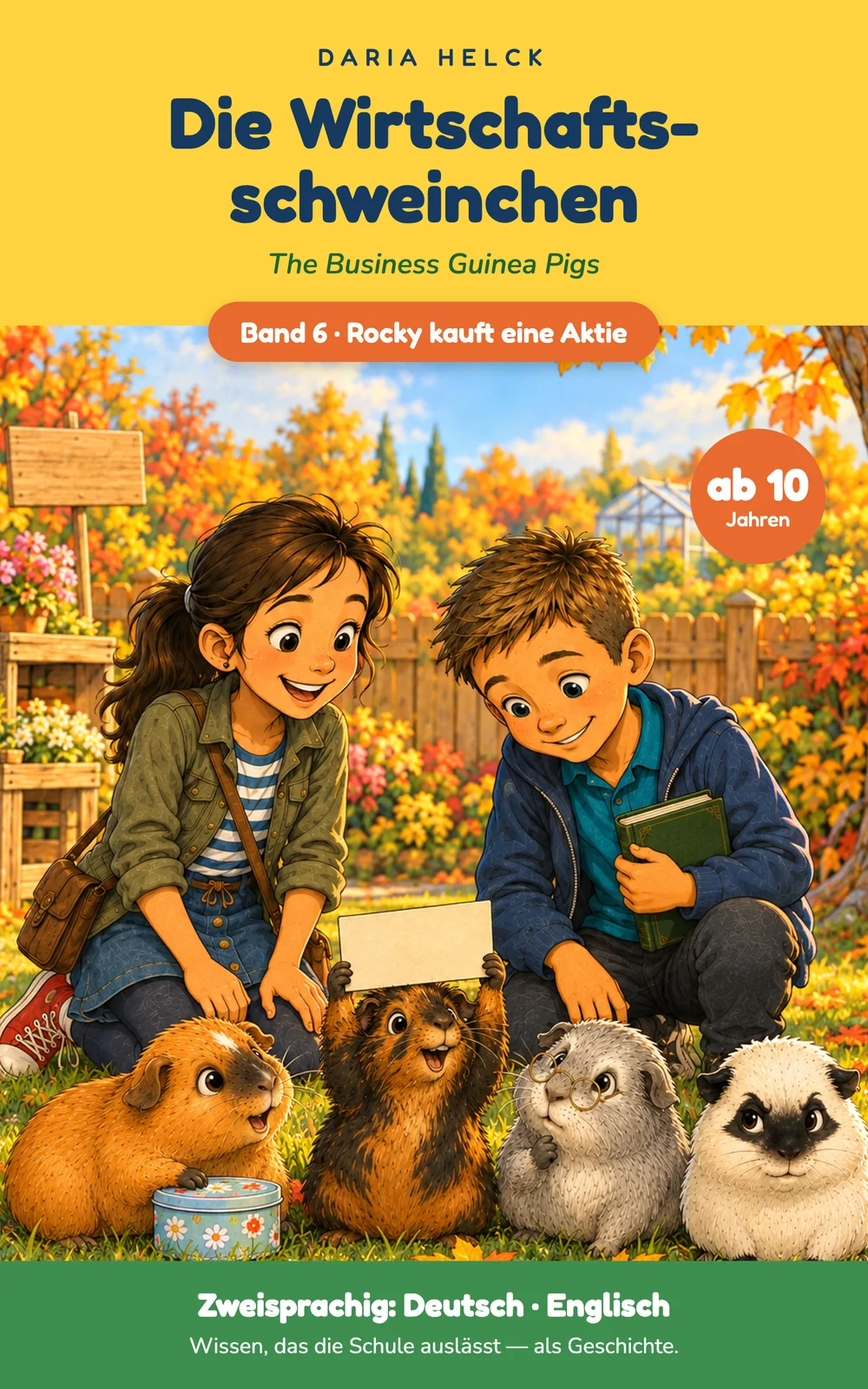
Rocky splits the old lemonade stand into twenty cards and sells nineteen of them. What a share is, how a share price gets set and why co-owner doesn't mean boss. For kids 10 and up.
Because they see the same situation from completely different angles, money and business become something you can actually get your head around. Here they introduce themselves with the line from their profile.
From “How much allowance?” to “What is a share?”: the short answers, each with a link to the full page.
How much allowance is right?
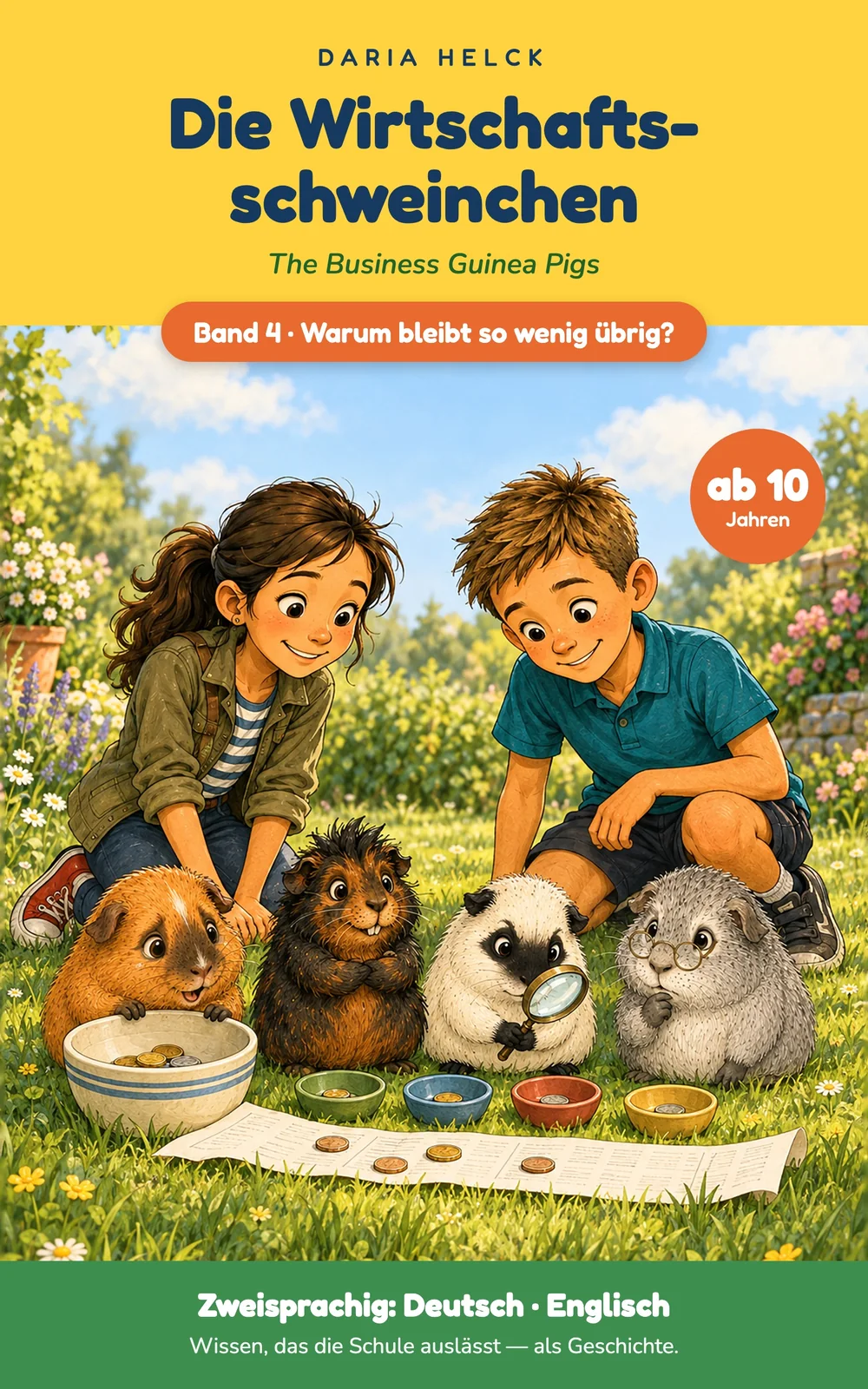
In Germany, the German Youth Institute (DJI) recommends ranges: €3 to €4 a week at ages 8 to 9, €15 to €25 a month at 10 to 11, €20 to €30 at 12 to 13, €25 to €45 at 14 to 15 and €40 to €60 at 16 to 17. What matters most is what your child is expected to pay for out of it. These amounts are recommendations, not rules.
Up to age 9, the German Youth Institute gives weekly amounts, and from age 10 monthly ones. From about 12, it also recommends a budget allowance for regular expenses like clothes or school supplies. Allowance should come regularly and is neither a reward nor a punishment.
Kids can buy small things on their own if they pay for them right away with their own allowance: an ice cream, a comic book, a bag of carrots. Many people know this as the Taschengeldparagraph, the “allowance law.” But for an order you pay for later, a subscription or a payment plan, you need a parent’s yes. Without that yes, the contract hangs in the air, and if the parents say no, it’s gone.
In Germany, kids under 13 aren’t allowed to work. At 13 and 14, light tasks are allowed, but only with their parents’ okay, for no more than two hours a day and never during school. From 15, holiday jobs are allowed too.
Taxes are part of the money you earn that you hand over to the government. The government uses it to pay for things everyone needs: roads, schools, hospitals, the fire department. Mojito calls taxes the shared food bowl of an entire country: everyone puts something in, and everyone gets to eat from it, even those who have nothing right now.
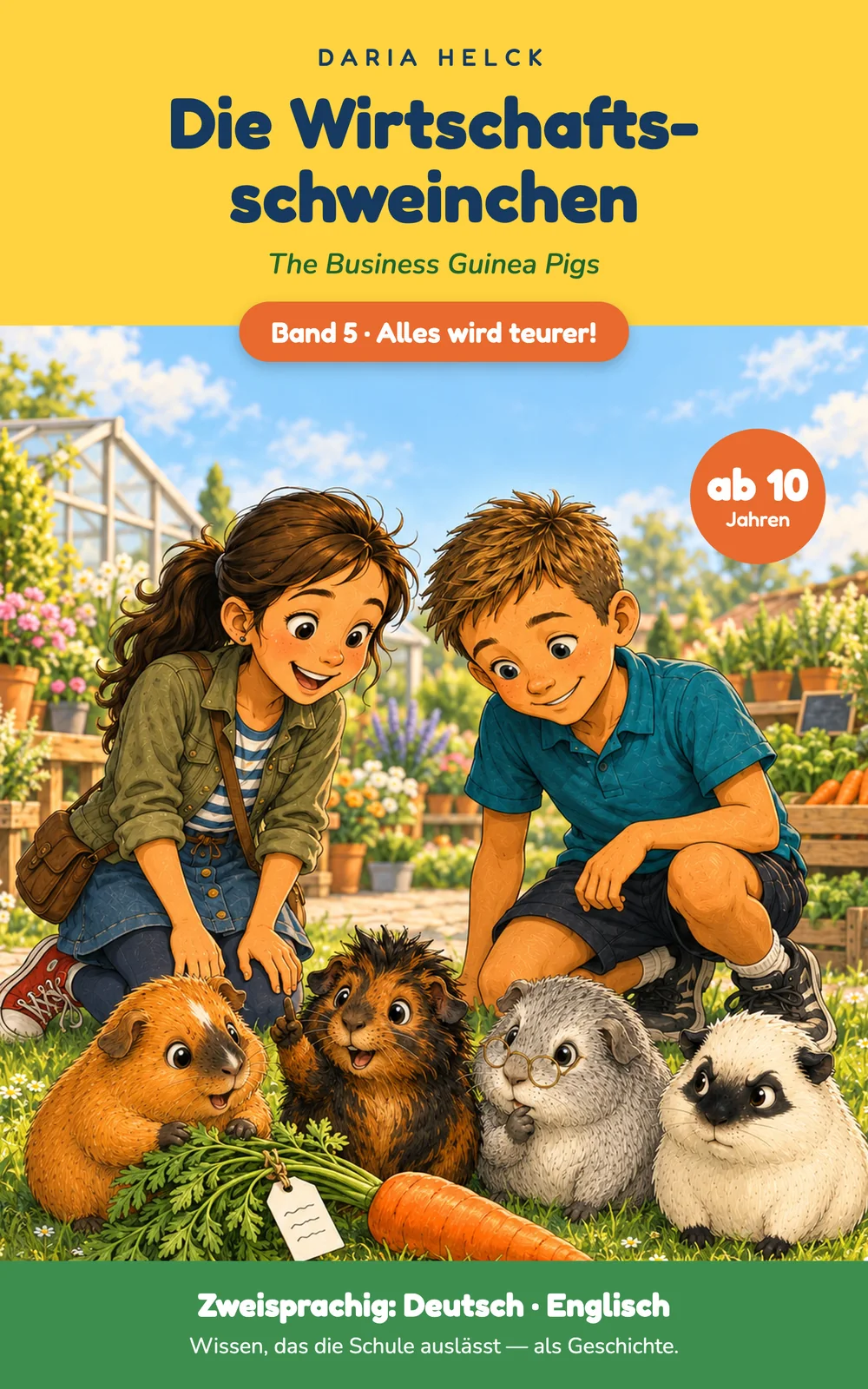
Inflation is when many prices rise over a longer time. The money doesn’t get smaller. It buys less. Daria nails it: Not one thing by a lot. Many things by a little. One expensive carrot is not inflation yet. A whole basket getting more expensive is another matter.
A share (shares are also called stock) is a piece of a company. You own a part of it. In the book, the old lemonade stand is split into twenty cards. Whoever has a card owns one twentieth of it. Someone who owns a share is called a shareholder. That makes them a co-owner, but it doesn’t make them the boss. Not even close.
For kids ages 10 and up, so roughly from fifth grade on. Nobody needs to know anything about economics or finance beforehand. The series is a great fit for curious kids who want to know why everyday things work the way they do.
Yes. Every paragraph appears in German first, with the English right below it. Kids who read the story in German pick up the English words and phrases along the way, and kids who read it in English can pick up German as they go. Each volume also has a dictionary of the most important terms in both languages.
Yes. Rocky, Mr. Grey, Toffy and Mojito are based on real guinea pigs who live with the author’s family. And the kids Daria and Christian share their names with FLITCH’s founders, Daria and Christian Helck.
All published volumes are available on Amazon as paperbacks and Kindle eBooks. The printables, such as Die Schweinchenkasse, an allowance planner (€6.90), and the coloring book (€4.90), both in German, are for sale in the shop at flitch.fun and on Etsy; individual worksheets and two coloring pages are free in the FLITCH Club. This website itself doesn’t sell anything.
Each volume tells an everyday story and can be read on its own. Every paragraph is in German with the English right below it, so kids can read in English and pick up some German along the way.
Rocky, Mr. Grey, Toffy and Mojito aren't made-up mascots. They really live with us. In summer they're outside in their big outdoor enclosure; in the cold months they move into their quiet winter quarters inside the house. In the books they talk a bit more than in real life. Usually.
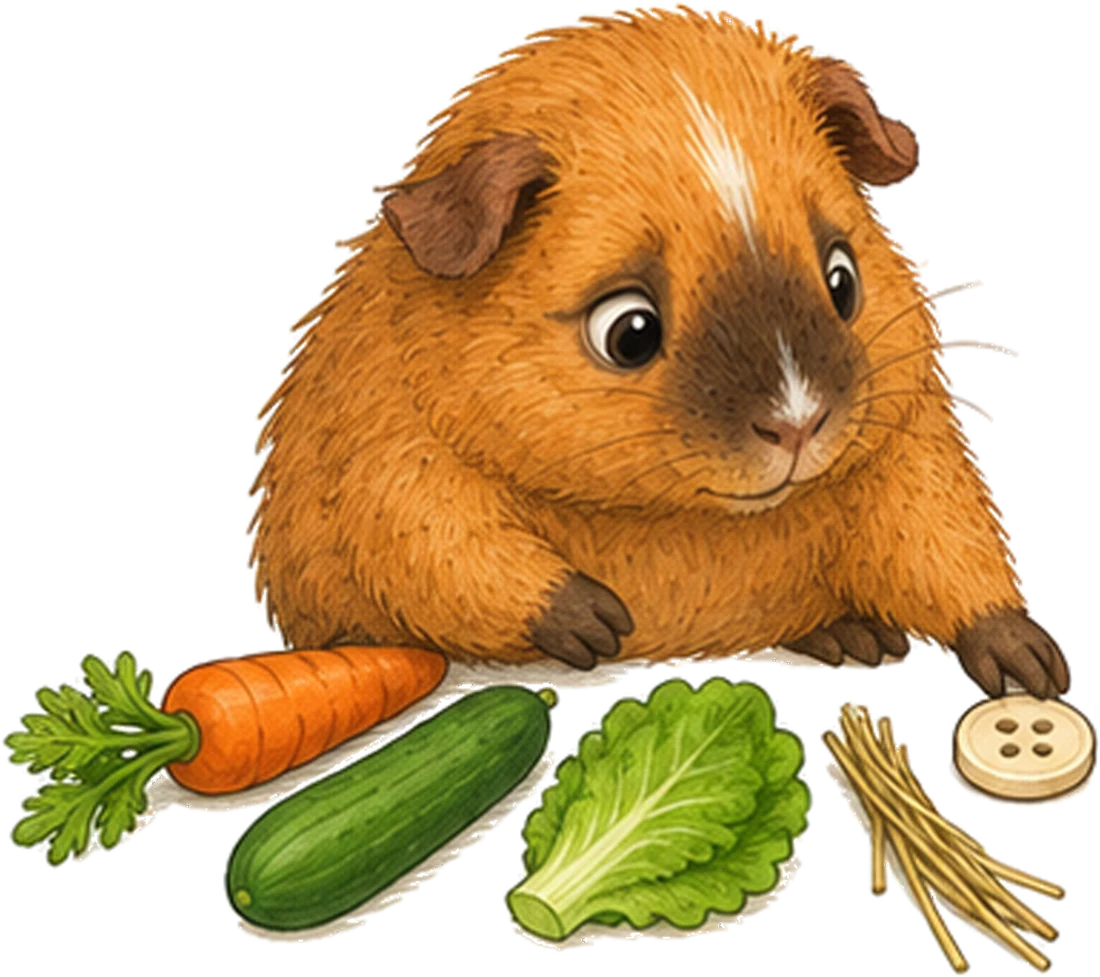
Rocky Picked by our son. He looks like a little rock star.
Mr. Grey Wasn't supposed to come home with us at all. Then Christian spotted him, as gray as his name.
Toffy Also our son's pick, warm and creamy like toffee candy.
Mojito Daria's very own guinea pig, named after her favorite cocktail, even though he looks more like a piña colada.
The FLITCH Club has free single pages to go with the books: the “My First Lemonade Stand” math worksheet from Volume 1, two coloring pages for Volume 1 (Rocky's big idea, Toffy's lemonade stand), a certificate and materials for parents who want to talk with their kids about money. Plus new little extras, added regularly. All you need is an email address; signing up is a job for the grown-ups.
Not part of the Club: the Business Guinea Pigs coloring book (€4.90), Die Schweinchenkasse, an allowance planner (€6.90), and the Advent coloring calendar (€4.90). They're German-language booklets you can buy in the FLITCH shop and on Etsy.
1. Which guinea pig explains this? “Too cheap always smells like a catch.”
For parents and teachers
Reading along with a child?
Here you'll find ages, learning goals, the topics in each volume, sample pages and materials for school. The books are educational stories: simplified for kids, accurate on the facts, and not financial or legal advice.