The Business Guinea Pigs – Volume 6: Rocky Buys a Share
Shares explained simply for kids: twenty cards and an old lemonade stand.
Rocky reads about shares in Mr. Berger’s newspaper and immediately starts planning his office, complete with a boss chair and a sign. There’s just one problem: he doesn’t have any money. So he divides the old lemonade stand into twenty cards and sells nineteen of them to Daria, Christian and the other guinea pigs. Now he has money. But only one single card still belongs to him.
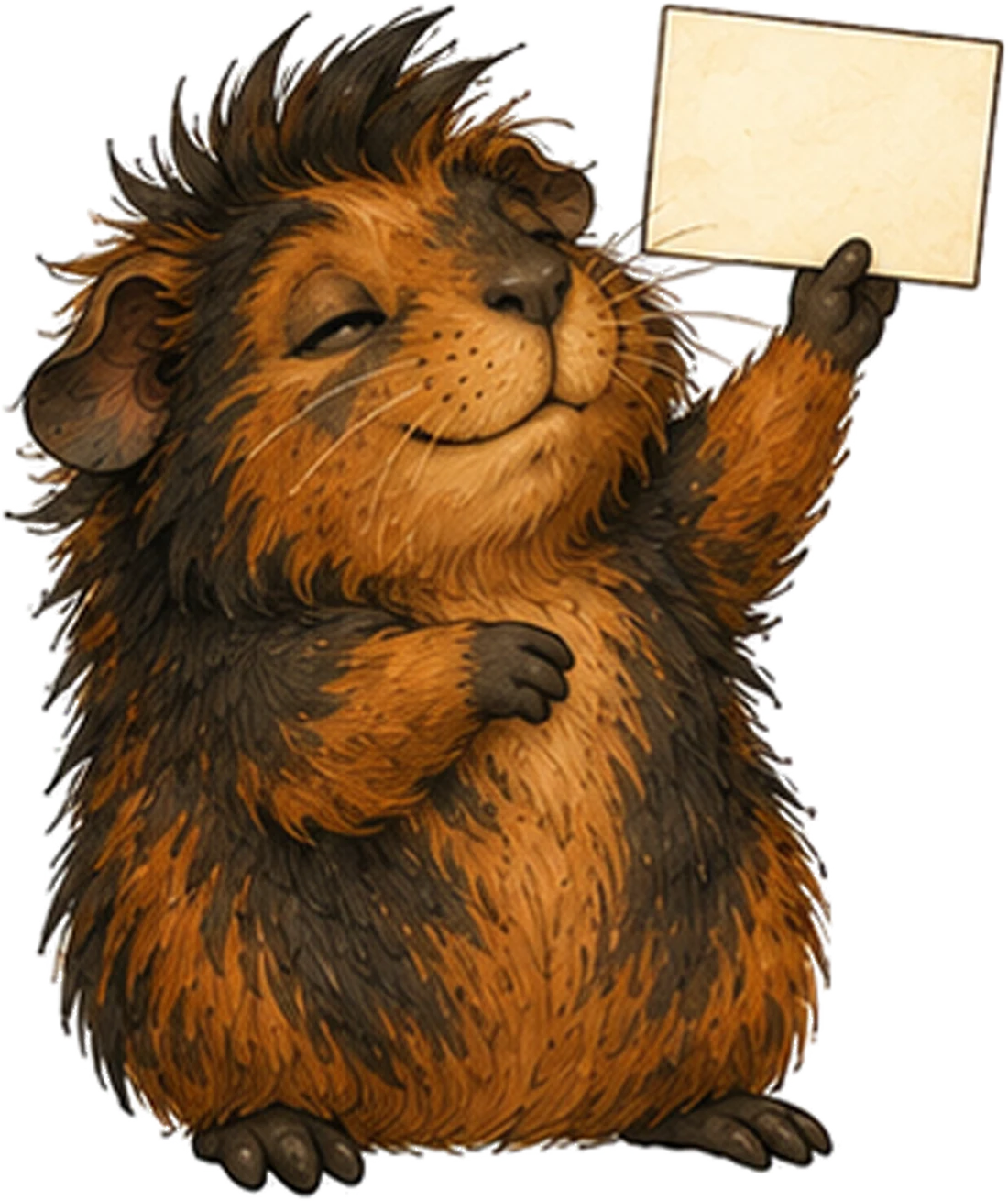
And then the same card costs four carrot slices in the morning and just one in the evening. Nothing about the card has changed. Only how many people want it.
- By Daria Helck, published by FLITCH UG
- For kids ages 10 and up, roughly grades 5 to 7
- Bilingual: every paragraph in German, with the English right below it
- 92 pages, illustrated in full color throughout
- Available as a paperback and as a Kindle eBook
Paperback €16.99 · Kindle eBook €7.99 · Amazon prices as of October 2026
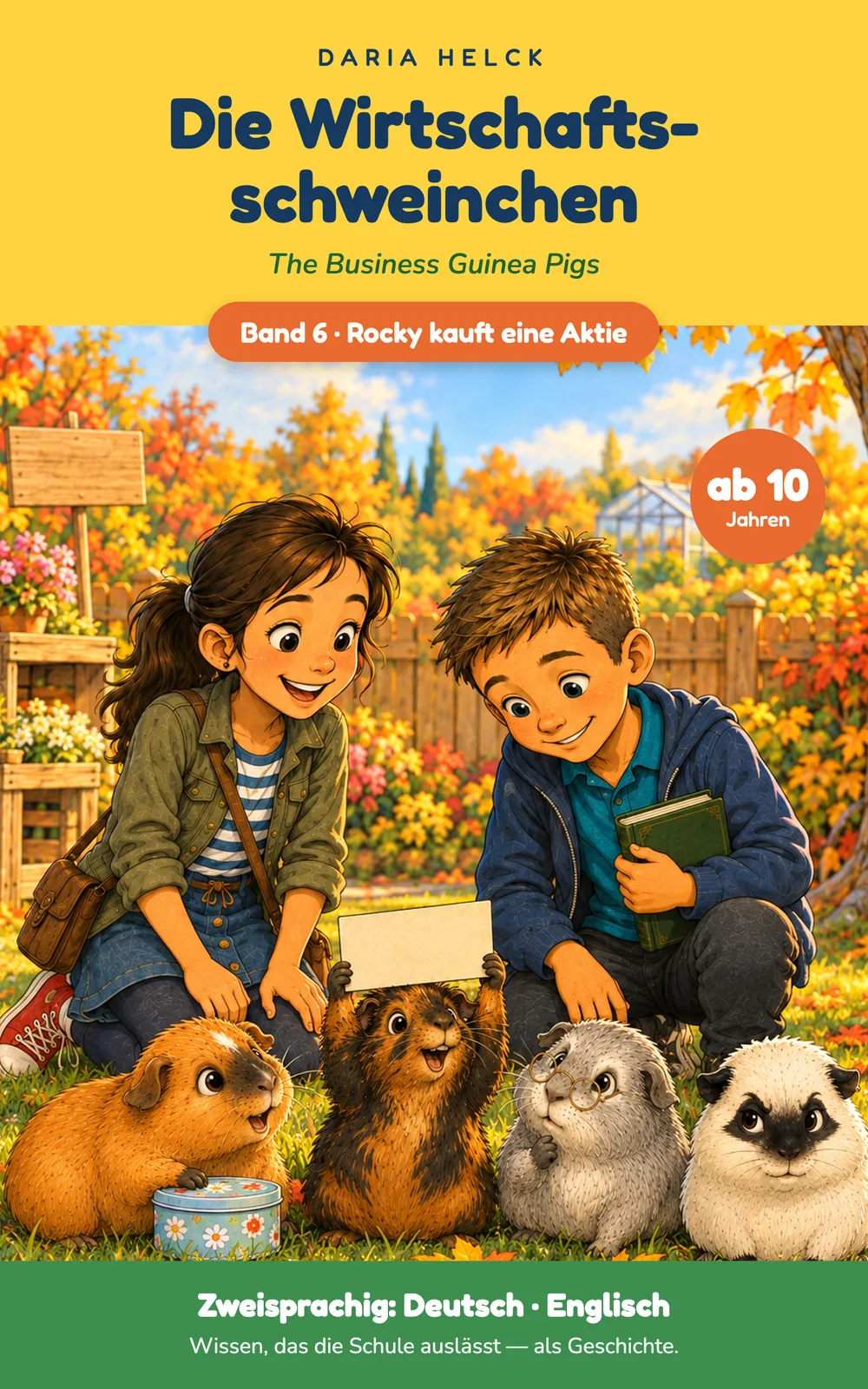
Good to know: every book in the series is bilingual. Each paragraph is printed in German, with the English right below it, so kids can enjoy the story in English and pick up German along the way.
What Volume 6 is about
Rocky is sure of it: if you own a piece of a company, you’re the boss. This book explains why it isn’t quite that simple. After the sale, Rocky owns just one card, and he still wants to give the stand’s sign a new name. The other nineteen cards vote against it. Co-owner doesn’t mean boss.
In the end, the kids buy a real share from their neighbor, the proper way and together with their parents. And Mr. Berger tells them the most important sentence in the book: Anyone who only tells you that you can make money with shares isn’t telling the whole truth.

Shares explained simply: what Volume 6 teaches
The book answers these questions. Here’s a quick summary, with the examples from the story.
What is a share? Explained simply for kids
A share (shares are also called stock) is a part of a company. You own a piece of it. In the book, the old lemonade stand is divided into twenty cards. Whoever has one card owns one twentieth of the stand. Someone who owns a share is called a shareholder. That’s all it means, says the guinea pigs’ dictionary.
Does owning part of a company automatically make you the boss?
No. Rocky owns a piece, and he still can’t just rename the sign. Whoever has more shares usually has more votes, and on important matters all the shareholders vote. The managers run the company day to day. At Squeak & Squeeze that’s Rocky, but only as long as the others let him.
Why does a company get money when it sells new shares, but not when a shareholder sells theirs to someone else?
When the company sells new pieces of itself, it gets the money and gives up some ownership in return. But when you buy an existing share from someone, the money goes to the seller, not to the company. Christian draws the two directions to show it. When Mr. Berger sells his share, not a single cent goes to the greenhouse company.
What is the stock market, and how is a share price set?
The stock exchange is a market where shares change hands. That’s where buyers and sellers meet. The share price is the price at which someone is buying and someone is selling right now. What someone would pay is only an offer. Christian’s line: That’s an offer. Not a price yet. And the share price doesn’t tell you what the company is worth.
Why does a share price go up and down?
Because expectations change, not the company. One card, two buyers: four carrot slices. Four cards, one buyer: one. Christian can rebuild the cards, but not what somebody believes will happen tomorrow. That’s why Mr. Grey asks: Did the company get better overnight? Usually not.
Does profit automatically mean money in your paw?
No. Profit is what’s left over. A company can pay out part of it to its shareholders, and that’s called a dividend. Whether it does, and how much, isn’t set in advance. It can also put the money into a reserve in case something breaks. For the guinea pigs, that’s the one euro in the jar.
What does spreading the risk mean?
Putting your money into several things instead of betting everything on one carrot. Mr. Grey’s line: Spreading distributes the risk. It doesn’t make it go away.
Can kids buy shares?
Not on their own. They can only do it together with their parents. Before you invest any money, three questions from the book help: When will I need the money again? What will I do if the share price falls? Have I spread it out, or bet everything on one carrot? The book explains how shares work. It doesn’t tell you which ones to buy.
The most important lines from the book
In the book, every paragraph is in German, with the English right below it. Same here.
- „Mitbesitzen heißt nicht nur, dabei zu sein, wenn es gut läuft. Es heißt auch, mitzutragen, wenn es schiefgeht.““Co-owning doesn’t only mean being there when things go well. It also means carrying your part when things go wrong.”
- „Man kann damit Geld verdienen. Man kann damit auch Geld verlieren. Wer nur die erste Hälfte erzählt, erzählt nicht die Wahrheit.““You can make money with it. You can also lose money with it. Whoever only tells the first half isn’t telling the truth.”
- „Das ist ein Gebot. Noch kein Preis.““That’s an offer. Not a price yet.”
- „Der Anteil ist derselbe. Der Preis ist anders.““The share is the same. The price is different.”
- „Streuung verteilt das Risiko. Weg ist es nicht.““Spreading the risk shares it out. It doesn’t make it go away.”
- „Nicht jedes Geld hat dieselbe Aufgabe.““Not all money has the same job.”
Words from the book: German and English
At the back of the book is the Business Guinea Pigs’ dictionary. Here are a few of the words:
- Aktie · share
A part of a company. You own a piece of it. - Mitbesitzer · co-owner
You own a piece. That doesn’t make you the boss, not by a long shot. - Aktionär · shareholder
Someone who owns a share. That’s all it means. - Börse · stock exchange
A market where shares change hands. - Kurs · share price
The price at which someone is buying and someone is selling right now. It doesn’t tell you what the company is worth. - Dividende · dividend
Part of the profit that a company can pay out to its shareholders. - Rücklage · reserve
Money that stays put in case something breaks. For us: the one euro in the jar. - Streuung · spreading the risk
Putting your money into several things. The risk gets spread out, but it doesn’t go away. - Chance und Risiko · opportunity and risk
They always go together. Whoever only tells you about the opportunity isn’t telling the truth.
Dear parents, in this volume Daria, Christian and the four guinea pigs divide their old lemonade stand into twenty cards and act out what a share is. In the end, the proper way and together with their parents, they buy a real share from their neighbor.
Three insights carry the book. The first: Co-owner doesn’t mean boss. Rocky owns a piece, and he still can’t just rename the sign. The second: Price is not value. The same card costs four carrot slices in the morning and one in the evening, without anything about it having changed. The third comes from Mr. Berger: You can make money with shares and you can lose money, and anyone who only tells the first half isn’t telling the truth.
Questions for talking it over afterward: Why does Daria have five votes and Toffy only two, and is that fair? Why does the company get nothing when Mr. Berger sells his share? And in your family, which money has which job? You don’t need a brokerage account for the answers, just a kitchen table.
Daria Helck in the afterword of Volume 6

Join in and keep talking
At the back of the book you’ll find all the cards, share prices and votes from the story at a glance, plus math exercises to try along the way. If you like, act it out: divide an old toy into twenty cards, sell the cards, and watch what happens to the price when suddenly everyone wants one.
Questions to keep the conversation going
- Why does Daria have five votes and Toffy only two? Is that fair?
- Why does the company get nothing when Mr. Berger sells his share?
- What would you do with a profit: pay it out or put it in the reserve?
- In your family, which money has which job?
What’s inside the book
- 10 chapters, one continuous story
- Every paragraph in German, with the English right below it
- Six explainer pictures, including new shares, the share price and dividends
- The Business Guinea Pigs’ dictionary with 22 terms in German and English
- All the cards, share prices and votes from the book at a glance
- Math exercises to try yourself
- Good to know: shares and kids
- Profiles of all the characters
- A word to parents
- 92 pages, illustrated in full color throughout
Free in the FLITCH Club: individual worksheets, two coloring pages and pages for parents that go with the books. For sale in the FLITCH shop, all in German: the coloring book (€4.90), Die Schweinchenkasse, an allowance planner (€6.90), and the Advent coloring calendar (€4.90).